
Nathan Mayo staff portraitNathan Mayo
Vice President of Operations & Programs
Read more from Nathan


Listen to this article:

Check out True Charity Ennoble on Apple Podcasts and Spotify.


“Collaboration” is one of those concepts almost universally accepted in theory but far less prevalent in practice. There are few people who will argue that more conversation and information-sharing between organizations could do anything but improve results in poverty alleviation. In a surprising twist, allow me to be one of the few who is more skeptical.

To be sure, the logic of collaboration is sound. 

For instance, it can help identify that all three food pantries in your community are only open at the same time on Tuesdays. As well, a good referral network can get someone to the right place faster. Also, redundant paperwork, duplication of services, and questionable “double dipping” can be reduced or eliminated by better collaboration among local church and nonprofit service providers.

In fact, True Charity originated as a local promoter of ministry collaboration. Our earliest days were spent rallying local leaders to sign up for a case management information sharing system. And yet, despite our bullishness on the idea, it has failed more often than succeeded.

Granted, there is evidence that targeted “collective impact” interventions can make a difference over decades. But for every success, there are legions of community coalitions that cannot show they’ve made a meaningful impact on poverty, homelessness, or related metrics.

So why do a select few collaborative efforts work, when most fail? There are several reasons, some of which constitute general headwinds that can blow collaboration off course — and one is a solitary kraken so powerful that it dashes the strongest intentions against the rocks.

The headwinds (and their solutions) include:

  • The tyranny of the urgent, which can be addressed by the painstaking work of helping people see how the coalition furthers their organization’s mission more effectively.
  • Implosion on launch. The coalition was assembled too soon and didn’t have the right people in the room. Forging a successful coalition requires a dedicated leader making 1-to-1 visits a good nine months prior to the first meeting. The fastest way to kill a coalition is to call a meeting too soon.
  • Meetings fizzle out because they’re not valuable, which requires good facilitation and limited, achievable objectives from the outset. People need to see results from the meeting or they won’t keep attending.
  • Coalitions break down because the leader’s judgment is in question. This one can be addressed with some democratization. Key stakeholders must have meaningful input in direction and leadership in order to remain committed. Say-in produces buy-in.

But even when all these things are right, the kraken looms and as mentioned, it’s a monster problem that undermines collaboration in the poverty space.

It feeds on a faulty presupposition: that collaborators are already doing effective individual work. Thus, the way to “take our work to the next level” is to do good work in coordination with other people doing good work.

Yet the reality is that in poverty alleviation, the majority of providers are doing perpetual crisis relief, which is fundamentally ineffective.

More efficient distribution of low to negative impact solutions doesn’t generate high impact solutions. For example, if handing out sandwiches at the park is a poor way to get people out of homelessness, then coordinating multiple ministries’ sandwich handouts still won’t make a difference. Or if a network of agencies deal with generational poverty by providing an array of free goods, services, and government benefits, then a referral system will only intensify the range and depth of unhealthy dependency.

In short, the bulk of service providers provide perpetual crisis relief in contexts where development is needed, often to counterproductive effects, as documented in books like When Helping Hurts and The Crisis of Dependency

The pre-requisite to any effective collaboration must be that some critical mass of ministries start providing relational, long-term solutions in-house before they start integrating them across town. The good news is that once a few ministries begin that deeper, more effective work (versus just doling out soup), they quickly realize the need for a referral network.

A food-coop needs to partner with developmental classes. A shelter needs to refer its clients to a long-term life transformation ministry or transitional housing program. A group mentorship model for the working poor needs a transportation ministry to address barriers to employment.

To put it another way, development is more specialized, reaching a smaller group of people — and is of longer duration. It demands collaboration—which will work—but only when seen as the second step to serving your community well.


If you’re a network member, we have tools that can help! Want help building buy-in for effective charity at the organizational level? Check out our sharing guide. Are you ready for collaboration? Follow our process to tackle the headwinds in the Coalition Building Toolkit.


Bethany Herron staff portraitBETHANY HERRON
Vice President of Education
Read more from Bethany


Listen to this article:

Check out True Charity Ennoble on Apple Podcasts and Spotify.


If you’re like me, your deep love for people can make knowing where to invest your time and financial resources overwhelming. Too many needs. Too little time and resources. 

That’s why I’ve been thinking a lot recently about what a true return on charity investment should look like.

I’ve been reminded of a story about a man approaching seventy. For the first time in decades, he was worshipping in church alongside his grown daughter. As they sang, she watched tears fall from his face while he declared, “Yet not I but Christ in me.” After years of living in and out of addiction-driven poverty, Christ enabled him to do what he could not do on his own: move closer than ever to a flourishing life.

That is impact — and a true, eternally-significant return on investment.

To unpack the story further, throughout his life, his family received many forms of charity. Electricity bills were covered. Vehicles were repaired. Disability payments were provided.

But often, that charity unintentionally fueled his addiction instead of helping him find freedom. The real change came only when restored relationships entered the picture — specifically with God and his family.

Stories like this remind us that not all mercy ministry is truly merciful. Some forms of charity can unintentionally harm the very people and families they aim to help.

Until we embrace our mutual brokenness, our work with low-income people is likely to do more harm than good. I sometimes unintentionally reduce poor people to objects that I use to fulfill my own need to accomplish something. I am not okay, and you are not okay. But Jesus can fix us both. – When Helping Hurts

That means for faith-driven philanthropists or churches looking to partner with charity organizations, where you give — and what kinds of efforts you give to — matters.

Here are five questions you can ask an organization before financially supporting it:


1. What does success look like for the people you serve?

Effective organizations articulate their goal and align their efforts to meet the spiritual, physical, emotional, and intellectual needs of people created in the image of God — in other words, those who have the capacity to contribute to society.


2. Are you asking people closer to the problem to help out first? 

People closest to the individual should do their part before other people and institutions step in. That starts with the individual themselves, then extends to family, friends, churches, nonprofits and, if necessary, the government.


3. Do you prioritize genuine, reciprocal relationships?

Good ministries seek to foster and maintain mutual relationships with the poor and to connect them to new relationships, which help them increase their social capital.


4. Do you empower clients to NOT need you in the future?

True charity is not done “to” someone, but it empowers a person to support themselves in the future. Even if someone doesn’t have the capacity for full financial independence, good programs help those people grow in other ways.


5. Do you measure long-term outcomes in the lives of the people you serve?

Great programs track meaningful changes like improvements in housing, employment, education, and relational health. Measuring activity like “groceries given” or “clients served” doesn’t prove those organizations are making a difference.

Indiscriminate charitable giving makes financial philanthropy the endgame. Yet while our contributions should serve as a spark, they must be made to boots-on-the-ground organizations that ignite lasting life transformation in those they serve. 

If you’ve been searching for a place like that, where you can give with the confidence your dollars will make an eternally significant impact, consider partnering with True Charity. We are a nationwide team of over 265 nonprofits and churches who understand ineffective charity is harmful. Instead, our multi-faceted approach equips organizations to build transformational programs and influence policies that lead to a more flourishing life.


For more information on True Charity and how you can be involved in financial efforts that create a different, eternally significant ROI, visit us at truecharity.us.

ALYSSA GLASGOW
Graphic Design Manager
Read more from Alyssa


Listen to this article:

Check out True Charity Ennoble on Apple Podcasts and Spotify.

If you’ve been in marketing for any length of time, you probably know only a fraction of our social media followers actually see the content we post, let alone engage with it. That confirms what many of us know as the “Rule of 7.” That is, a person must see one message at least seven times before taking action. So rather than feel guilty or ineffective about posting the same content over and over again, why not use the rule to your advantage? 

In other words, let’s work smarter, not harder! Repurposing content with a fresh look or utilizing a different format will help fill your social media calendar without constantly generating new material — and remind your audience to take action on what they’ve already seen. Let’s look at an example from my work with True Charity.

Recently, we revamped our homepage to better convey our organization’s history and mission.

Starting with this content, I reshaped it into a few different formats to help our message travel further. Let’s take a look at three of them.

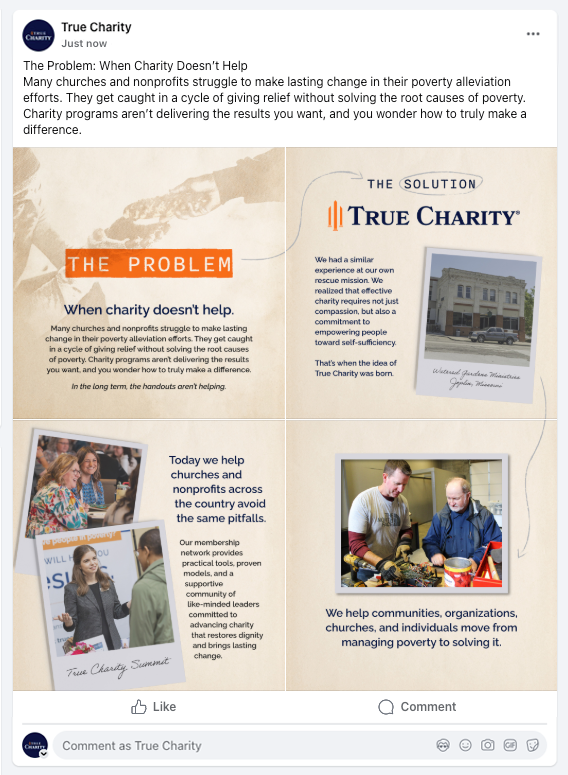
First, I created a social media post by reformatting the story using visual graphics. Retelling the story in this way brought a fresh look to those who’ve already viewed our homepage and appealed to the visual learners in our audience.

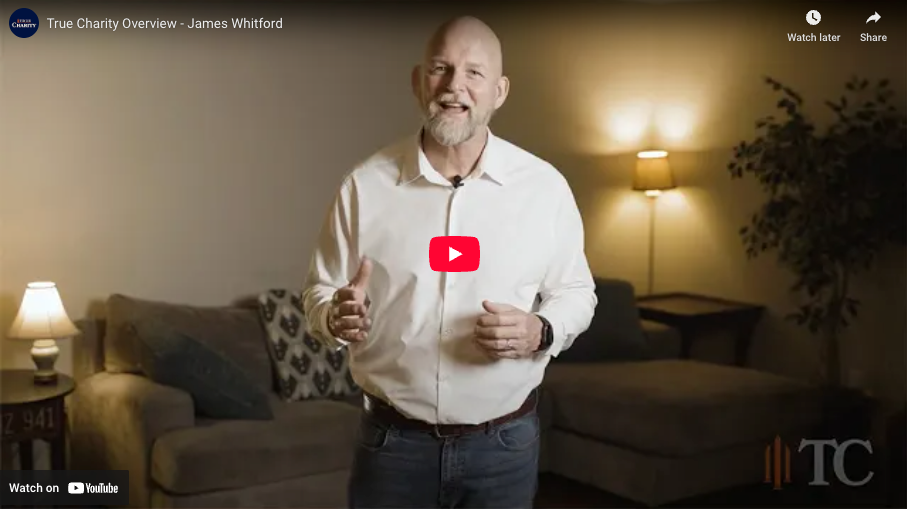
Second, I used video to share our message. According to Hubspot, short-form video delivers the highest ROI (return on investment) compared to other formats such as images and graphics, so to reach a whole new section of our audience, our videographer recorded James Whitford sharing True Charity’s story. As an added plus, videos can be shared on any of our social media platforms (including YouTube), further spreading our reach.

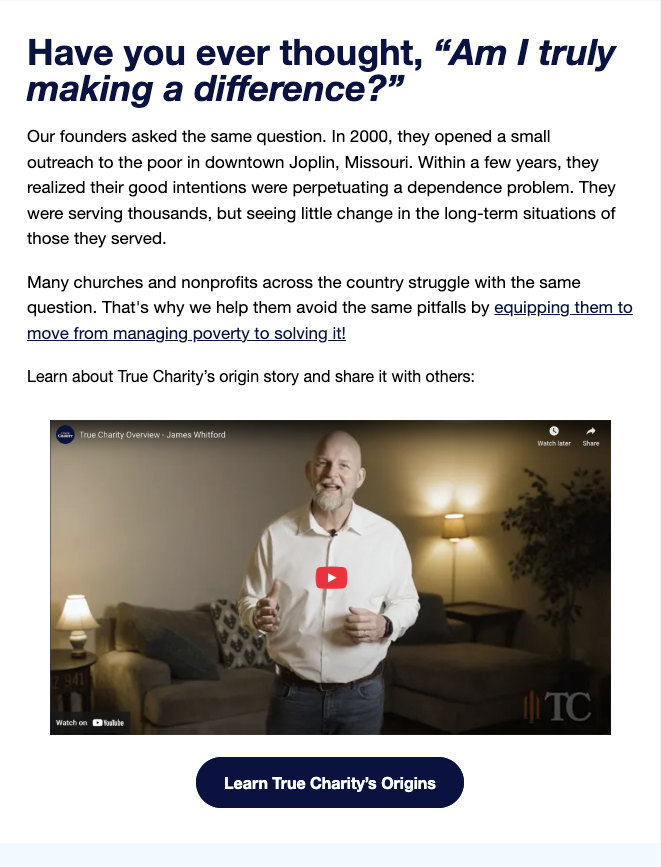
And lastly, I shared the content in an email, directing readers to our new homepage. So with just one piece of content, I created four versions to share with our website, social media, Youtube, and email audiences. 

Sharing the same content so many times may seem like overkill but think about this: How many times have you received another email reminding you to finally do what’s been on your to-do list for six months? (Speaking from experience here 🙋‍♀️). So from one busy person to another,  I encourage you to remember there’s no reason to reinvent the wheel. People need several nudges to seal the deal. Just reuse and repurpose your content to keep consistently fresh and persuasive messages flowing to your audience.


This article is just the tip of the iceberg for the practical resources available through the True Charity Network. Check out all of the ways the network can help you learn, connect, and influence here.


AVERY WEST
Member Engagement Director
Read more from Avery


Listen to this article:

Check out True Charity Ennoble on Apple Podcasts and Spotify.


This article was originally published by the Human Life Review.

America’s twin epidemics of isolation and low birth rates intersect in the heartbreaking experience of new mothers in America. 

In my short time as a mom (we have two toddlers and another on the way), I have spoken with women at libraries, pregnancy centers, churches, and parks. Regardless of background or status, their universal narrative is the same: Mothering in the “little years” is defined by a deep love for their children — but also isolation and a debilitating anxiety about “doing it right.” Many new moms are the only women they know having children. Some have never even held a baby. 

Sadly, women in poverty, whose babies are most at risk of being aborted, have even less social capital (community connections) than their middle and upper class counterparts. 

In other words, American motherhood is broken — but marriage and babies aren’t the problem. Fewer women are having babies and Americans are more isolated than ever, so new mothers can’t follow in anyone’s footsteps. They don’t know what happens to a woman’s body postpartum, how much to expect of an 18-month-old, or what a happy mothering experience looks like. The typical American woman today lacks a village — a community of women who will support her with not only meals and pediatrician recommendations, but also a late-night phone call when she’s crying alongside the baby, or a prayer in the parking lot when her husband is away for business. 

Throughout history, the Church has risen to meet societal needs on a large scale. Monks established the first hospitals. Sisters founded schools across the world to educate impoverished children. Priests started cooperative businesses to create jobs in the wake of the Spanish Civil War. These solutions weren’t just short-term outreach programs or “serve days.” They were — and are — sustainable institutions. 

Indeed, as the Church advocates for a culture of life, She can make it possible — attractive even — by helping facilitate that village. 

When my second child was born, I was lucky enough to benefit from a church village that was all about giving and receiving. Over the years, they brought me weeks of meals, offered eczema creams and tips on what to do when my baby was covered in red spots, and comforted me through my miscarriage. And when it was my turn to give, I dropped off meals, watched kids during doctors’ appointments, and, alongside my dear friend, coordinated our weekly “New Mom Community Night” for two and a half years. With a commitment to authentic relationships, we were able to create a space where mothers cried over past abuse, whispered timid dreams about the future, and rejoiced as they were baptized alongside their children.

We were committed to each other. During different seasons (Christmas, the summer, the time half the group gave birth within two weeks), we discussed taking a break. The response was always, “No! This group is the highlight of my week. I couldn’t survive without it.” When our church wasn’t able to support us with meals and childcare anymore, we willingly switched to a potluck model and rotated hosting the group in each others’ homes.

I was shocked that something so life-changing could be so simple: a few moms, meeting every week, talking about highs and lows, and sharing some food. That’s it. 

Of course, the mother’s group isn’t a new idea. MOPs and similar groups have been blessing church communities for decades. However, I believe we need to start thinking of these groups not just as growth opportunities for committed church members but also as an outreach for mothers at risk of abortion, i.e., as a pro-life ministry.  

In the modern Church, we often separate those two facets of Church life: internal ministry and external outreach. Yet mothers’ universal needs (e.g., postpartum depression and anxiety, isolation at home or work, dependence on Instagram for parenting advice, resentment for their husbands) span socio-economic spheres. That means the Church has an incredible opportunity to meet the desperate relational needs of all women—whether they bought a $5 thrift store crib or a $1700 self-rocking bassinet. 

Of course, a mother dealing with poverty does often bring extra needs to the table: underemployment, unreliable transportation, or a dangerous boyfriend. Yet, where better to learn about new jobs, used cars, and respectful relationships than a loving community? 

This isn’t all theory, either. Several women who attended our group had overwhelming needs. Of course, no charity program has a quick fix, and often, you only see changes when looking back after years. Even so, beautiful stories from our community emerged: A very young mom with no transportation eventually made friends in the group who took her grocery shopping and drove her and her baby to the hospital one night. Another friend, who had no example of what order in a family looked like, began weekly finance and planning meetings with her boyfriend after learning that this system helped another woman in the group stay on the same page with her husband. And one mom, after learning her abortion was not something she should “just get over,” experienced profound healing at a Rachel’s Project retreat she learned about through the community. 

None of this “ministry” was part of our regular programming. It’s just what you do for your friends. 

A mother’s support group is not just an outreach ministry that tells someone about Jesus and hands out some food or clothing: It welcomes struggling individuals into the culture and family of the Church.

So, how to begin?

In order to facilitate this pro-life ministry in your church, you’ll need to start with two or three welcoming, nurturing leaders deeply committed to the value of relational ministry. I’d suggest each group leader take a training course like “Beyond Volunteering,” or read through Becoming Whole. Resources like these enable a  fundamental shift in one’s image of charity from filling another’s empty bowl to walking alongside them for the long-haul. 

These leaders also need husbands who are committed to this important work.  They will be the ones to comfort their wives after hearing a particularly heartbreaking story, to encourage them to persevere with a mother who seems hardened to the world, and to take the children to the backyard so moms can discuss sensitive topics.  

The leaders can coordinate potluck-style meals and where the group should meet (i.e., a church nursery, outdoor playground, or in a group member’s home). If the church has extra resources and volunteers, it can even provide meals and childcare (though those things aren’t necessary). We learned that authentic connection is the most important element. 

To help kick off conversation, you can bring in outside experts (we had everyone from financial planners to lactation consultants) or work through a class like Faith and Finances or Love and Logic together. 

To get the word out to the broader community, we partnered with local pregnancy resources centers and nonprofits, hosted advertising events like “maternity clothing swaps,” and even messaged women who posted about their loneliness on local motherhood facebook groups.

This kind of ministry taps into an extremely underused volunteer base — mothers. Moms of young kids often can’t volunteer at pregnancy centers or other ministries because they aren’t allowed to bring their children along. This ministry actually thrives when the host’s children are running outside with everyone else’s. 

Just earlier this week, I was speaking to a neighbor pregnant with her first baby. She shared her anxiety about losing time for hobbies, going back to work after a short maternity leave, and a changing relationship with her husband. I asked if she had a support system. “I have you” she replied hopefully, “and I was thinking I should join some kind of moms group, but I have no idea where to find one.”

Little did she know that within walking distance, St. Mary’s hosts a weekly get-together of mothers, where moms discuss everything from prayer life with a newborn to passing down old toddler coats. Sadly, the group hadn’t advertised outside the church walls, so if I hadn’t been there to tell her, how would she have known? 

A village of Christian mothers is an immense gift that we can share with a world desperate for connection. Let’s not hide our light under a bushel. 


The True Charity Network exists to help you learn, connect, and influence in the realm of effective charity.  Learn more about the Network here.

Already a member? Get access to all of your benefits through the member portal.


JEN REED
Guest Contributor


Listen to this article:

Check out True Charity Ennoble on Apple Podcasts and Spotify.


Nonprofits addressing homelessness often struggle with financial instability, reliance on grants, and public skepticism. What if your organization could generate its own revenue while empowering clients with job skills — and bring about a positive shift in public opinion?

Switchpoint didn’t wait for funding to change the game. They built small businesses that fuel their mission, create jobs, and prove nonprofits can be self-sustaining. 

Here are three steps they took to build thriving micro-enterprises:  

Step 1: Identify Business Opportunities Within Your Mission

Switchpoint started by asking a critical question: What resources and skills do we already have that could become income-generating businesses?

They saw the potential in resale and launched a thrift store that serves multiple purposes:

  • Revenue generation to fund operations
  • Retail job training for clients, giving them employable skills such as customer service, inventory management, and revenue management
  • A shift in public perception: Customers saw individuals gaining work experience, not just receiving care.

Step 2: Expand Into Unexpected Industries

But they didn’t stop at resale. They saw an opportunity in the booming coffee industry and launched Switchpoint Coffee Co., selling packaged coffee online and through local stores. Why coffee?

  • It’s a high-demand product with repeat customers.
  • The business is scalable. They started small, tested the market, and expanded gradually.
  • All profits go back into homelessness programs.

Step 3: Make the Leap to Self-Sufficiency

We all know it’s easy to stay in the grants and donations comfort zone. But nonprofits that create earned income models have greater long-term impact and stability. Here’s what Switchpoint learned in taking the leap:

  • Start small, but start now. Switchpoint didn’t need a million-dollar investment. They started with what they had and grew based on demand.
  • Training matters. Every micro-enterprise doubles as a job training program, ensuring that participants don’t just work but gain skills necessary for long-term employment.
  • Public perception changes when nonprofits innovate. Donors, policymakers, and volunteers engage more when they see organizations creating solutions instead of just offering aid.

How Can Your Organization Build a Social Enterprise? 

Switchpoint’s success proves nonprofits don’t have to rely solely on grants and donors. They turned small businesses into engines that are driving change. How can you duplicate what they’ve done? 

Look at your resources. What could be monetized into a business?

  • Do you have access to donated goods? If so, a thrift or resale shop could provide both funding and training opportunities.
  • If physical space is an issue, consider pop-up sales, online stores, or a warehouse model.
  • Think beyond traditional nonprofit ventures. Ask those you serve for ideas on consumer-driven, high-demand markets where small-scale entry is possible. Ideas include small-scale farmer’s markets; bicycle, small appliance or engine repair; and landscaping services. 
  • If launching a full-fledged business seems daunting, start by partnering with local retailers to sell a simple, branded product.

Learn more about Switchpoint

Learn more about True Charity


Nathan Mayo staff portraitNathan Mayo
Vice President of Operations & Programs
Read more from Nathan


Listen to this article:

Check out True Charity Ennoble on Apple Podcasts and Spotify.


In the past century, goods and services offered by businesses have improved dramatically. In every industry — finance, transportation, retail, etc. — quality and affordability have increased. Sadly, that’s far less true in the nonprofit world. Despite advances in supporting technology, case management and soup kitchens aren’t producing dramatically better results than our great-grandparents saw.

Why is that the case? 

It’s not a lack of funding, which has increased on a per capita basis several times faster than inflation. Instead, the answer lies in understanding “information environments” — which refer to the natural systems of information and feedback we use to make decisions.

Some are what behavioral scientists call “kind” environments. They are characterized by immediate, accurate feedback and consistent information flow, analogous to using a GPS to navigate a city with clearly marked roads: It’s easy to see where to turn next; and if you take a wrong turn, your GPS will recalculate and get you back on track. For instance, astronomy operates in a relatively “kind” environment. The movement of stars and planets follow predictable patterns, quantifiable rules, and offer crystal clear feedback on predictions.  Consequently, astronomical events like eclipses can be forecasted to the second and astronomers’ opinions tend to converge over time.

Other information environments are like navigating a trackless desert with no roads, signs, or cell signals. It’s easy to veer off course and never know it. This is called a “wicked” environment and is characterized by delayed or inaccurate feedback and inconsistent patterns of information flow. For instance, political pundits prognosticating about a new government policy can be influenced by extraneous factors that make it easy to post-rationalize any outcome as a success (or failure). This “wicked” environment explains why pundits have not converged in their views like astronomers have. 

If we apply this framework to business and nonprofits, we see that most businesses receive rapid and accurate customer feedback. If it’s ignored, someone else will take their customers. This drives the industry to produce better products and services over time — even if a given business isn’t operated effectively.

Nonprofits have no such auto-correcting features. They can stay afloat for decades by engaging donors with occasional success stories or feel-good volunteer experiences, ignoring whether charity recipients truly benefit. And since handouts will often be received with gratitude, even client feedback surveys may be insufficient to redirect a nonprofit to address root causes. This means many ministries are fully insulated from information that could help them improve their programs.

The good news is there are ways to mitigate this difficulty. Most of the medical field operates in a “wicked” information environment. When the town doctor of old listened to your heart and prescribed a bottle of pills, there was often no way of knowing whether his diagnosis was correct. Since patients often didn’t come back after treatment, he might not know if the patient improved or declined. Even if he knew his patient’s condition over the weeks and years following treatment, he would have never known for sure what role the medicine had on the outcome.

In that kind of information environment, medical advances were slow and sporadic, and widely adopted “innovations” were as likely to harm as help (e.g., mercury treatments and bloodletting). Yet, the field has steadily improved its patient results in recent decades. 

They accomplished this by combining the scientific method (to determine general best practices) with patient outcome tracking (to improve care at the local level). Think of it as using a map and compass to navigate through a barren landscape. It’s still a challenging information environment but it can be overcome with careful effort and the right tools.

This model of researched best practices combined with localized outcomes measurement can enable nonprofits to overcome challenges they face. They can proxy scientific research by learning from other organizations with exemplary results — and access well-designed experiments, too.

But even if programs are based on what works elsewhere, there’s no substitute for testing their local effectiveness. That involves more than measuring how much is given away. Measuring long-term results like stable housing, employment, education, and family reunifications should be prioritized. With the right tools and program design, it’s even possible to measure knowledge, motivation, and social connectedness. 

A common objection is that fleeting interactions with numerous clients makes measuring long-term effectiveness nearly impossible. Unfortunately, the same superficial interventions that make outcomes hard to measure make it likely a program isn’t producing much worth measuring.

The good news is that while effective measurements are a necessary cost of doing good work, they also help fund it. Donors (particularly major ones), granting organizations, and volunteers  have entrusted the organization with their gifts. They deserve to know their generosity makes an impact. When they see positive results, they frequently increase their contributions. Even paid staff will be encouraged by demonstrable results that affirm their sacrifice and service. 

Furthermore, effective outcomes measurement supports clients’ personal growth. Data collection usually takes the form of goal-setting conversations which enable clients to see positive change over time. For many, it’s the first time in years (if ever) the trajectory of their lives has been positive. Improving numbers on things like credit scores or weeks of sobriety gives them confidence their progress is real. It’s very true that in life, as in sports, people play differently when they keep score. Tracking progress and goals will inspire them to do their best.

There’s a final reason to measure outcomes: If we don’t, we may waste much of our career. None of us wants to realize that after decades of laboring in love, we are feeding the grandchildren of our original clients. But we are not doomed to wander in the wilderness. A combination of general best practices and local measurement can guide us and the people we serve to a better future.

Take your impact to the next level with True Charity’s Outcomes Toolkit, designed to equip you with actionable insights and proven strategies for effective charity.

And discover all the ways the network can help you learn, connect, and lead change here.
Already a member? Unlock your full range of benefits through the member portal.


SONYA STEARNS
Network Manager
Read more from Sonya


Listen to this article:

Check out True Charity Ennoble on Apple Podcasts and Spotify.


When an individual or family walks through the doors of your church or nonprofit asking for help, properly assessing their situation is the first step in their journey toward free and flourishing lives. One of the tools True Charity Network organizations use to do that is the client self-assessment survey, which provides a solid starting point for the journey to long-term stability.

Using Cantril’s ladder as the basis for most questions, it encourages individuals to think about their overall well-being, ranking different factors with a numerical scale. Their responses will help you (and them) understand more about their families, their self-concept, and their social capital.

The beauty of True Charity documents like the self-assessment survey is that they are adaptable, which means volunteers, staff members, and others can edit them to suit their region and desired outcomes. For instance, some think the term “client” sounds sterile and lacks a personable approach. If you feel this way, you can choose a more relational term like “neighbor,” “partner,” or “champion.”

Regardless of whether you use this exact True Charity tool as your initial intake form or implement a questionnaire you have used before, here are three approaches that will ensure better long-term results:


1. Set aside enough time to treat every individual or family with dignity and respect.

Implement an appointment-based system to help ensure the people you’re serving won’t feel like numbers in a rushed pandemonium. This will protect your time as well. You can set up Google Calendar, Calendly, and others for free on your church or nonprofit’s website.

It’s important to remember that often, people asking for help have been treated like a number so many times that they have shut down emotionally. Many have lost all hope of being treated with dignity and have stopped dreaming of being free from poverty. Thus, they may come across as demanding or entitled when, in fact, it’s what they’ve learned to do to survive.

Smile. Look them in the eyes and patiently help them evaluate their overall situation. Being in a relaxed atmosphere will help them understand both the positives and negatives of their current circumstance and grasp a realistic view of their state of affairs.

Also, remember that simply handing someone a questionnaire and leaving them isolated in a room does not communicate respect and care. Instead, guide them conversationally through its thoughtful questions. That will let them know you value them and want to know their story.

If it’s impossible to sit one-on-one with every individual, explain that they are important image bearers of God who deserve to be treated with dignity and respect. Communicate that you want to help them achieve long-term stability and can best do that by getting to know them through the questionnaire.

And please consider this: if time is a constant restraint, it may be necessary to reevaluate your program to allow for a more relational approach. True Charity’s Program Refinement Toolkit is available to member organizations to help toward this effort. Its PDF guide is free to nonmembers who subscribe to the True Charity mailing list or upon request at info@truecharity.us.


2. Use easy-to-understand questions that apply to the specific audience for your program. 

Every individual and context is unique. While you’ll find the questions on True Charity’s Client Self Assessment Survey fit a variety of situations, they won’t fit every context perfectly. Feel free to use only the questions relevant to your context.

Keep in mind that the average American reads at a 7th – 8th-grade level. Shape questions so they are easily understood. A free online tool like the Hemingway Editor can help simplify the language.

More and more network members realize that having Spanish-speaking volunteers makes a huge difference. Your region may have another prevalent non-English language group, so consider enlisting dual-language students or retirees to help. Many would welcome a part-time income, and some may want to volunteer their time.

Shape your programs’ check-in process according to your clientele. For example, Christmas markets and back-to-school programs attract parents and families, while church benevolence ministries and food pantries also serve single individuals. 


3. Plan for follow-through and continued development.

James Whitford, TC’s co-founder and CEO, often says, “Until we want to spend time with those in poverty as much as we want to solve the problem of poverty, we won’t see measurable results.” Re-read that sentence and let it sink in.

Continued communication with our neighbors increases the likelihood they’ll reach a stable and flourishing destination. To that end, a mentoring program with bought-in volunteers will be a natural relational venue for growth to take place.

Likewise, planning periodic check-ins is an effective way to stay in touch and strengthen relationships. Meeting an individual or family over donuts and coffee once a month might be easier than you think. Recruiting churches and new volunteers to join in these follow-ups is wise and will increase the social capital of those you’re serving.

Walking alongside those in need, helping them understand their opportunities, and following up regularly is a multi-faceted journey. Start it with an effective assessment of the situation. Doing so will put you on course to help those you serve achieve outcomes that demonstrate independent and flourishing lives!


The Client Self-Assessment Survey is only a small piece of the resources available to network members. To learn more about the True Charity Network, visit truecharity.us/join


Nathan Mayo staff portraitNathan Mayo
Vice President of Operations & Programs
Read more from Nathan


Listen to this article:

Check out True Charity Ennoble on Apple Podcasts and Spotify.


Ministry leaders who embrace both the agency of the individual and the existence of absolute truth often deal with a tension. For instance, on the one hand, you want to put a woman you’re serving in the driver’s seat of her own life, help her set her own goals, and achieve a destination of her choosing. On the other, her current destination of choice is to leave your program and move back in with an abusive boyfriend.

The temptation is to become paternal — that is, to assume she has no agency and needs to be told what to want and how to get it. Yet paternalism is a dreaded approach to serving the poor and rightly so. Most charity workers consider it a dirty word, preferring to help people make their own choices. And a Christian perspective can heighten the tension even more because we know that while there are numerous good choices one can make, some are unwise — and others are downright sinful.

Are people in poverty more likely to make imprudent or immoral choices? Biblically speaking, there are more admonitions given to the rich than the poor, so if anything, the middle-class and wealthy might face more temptation. However, the Bible also points out that certain vices can lead to poverty. Examples include laziness (Proverbs 6:10), wasteful spending (Proverbs 21:17), and addiction (Proverbs 23:21). Additionally, just as plenty of money can lead to temptations like pride, poverty can lead to temptations like stealing to make ends meet (Proverbs 30:7-9). Regardless of circumstance, all people, at any income level, are prone to making bad choices.

That’s why healthy relationships involve challenging the beliefs and plans of those we care about. It also involves simultaneously letting them take ownership of their lives while warning them against critical mistakes. That’s especially true if you’re in a case management or mentorship role, so here are a few things to keep in mind:

1.   Know the difference between facts and opinions

Ground yourself in what the Bible says about the right way to live but realize it leaves a lot open for personal application. Educate yourself on real stories of success for people in poverty. Don’t confuse your experience, denominational bent, or cultural preferences with absolute truth. You’re not the authority, but that doesn’t mean there is no authority. Evaluate on the basis of the following continuum: morality (e.g., not abusing illegal drugs); a general but not universal truth (i.e.,  getting a high school diploma/GED is a wise choice for most people); and personal preference (moving to seek a better opportunity elsewhere, which has pros and cons).

2.    Listen before you share

When people set goals, it’s distinctly possible they’ll come up with a bad idea — but they’ll doubtless come up with good ones as well. Give them the courtesy of determining the direction of the conversation and listen intently. Focus on what’s good about their goals and be quick to praise it.

3.    Be content with significant but intermediate progress

A client may have set some good goals — but you wish they would set more. For instance, they’ve built a budget and are saving money —  but you want them to save even more by not smoking a pack a day. As long as progress is significant, it’s better to encourage it than to pile on more expectations. And it’s wise to avoid unnecessary disagreement — you’ll do more good as a coach than a life planner.

4.    If you must disagree, point back to absolutes

Suppose someone you know plans to work for cash “under the table” to qualify for welfare benefits. This is both unwise and immoral. Rather than relying on your own wisdom as the rationale for explaining why it’s a poor decision, point to scripture. And be sure to point out how scripture has challenged your decisions in the past. Remind him or her it is an authority to which we all must submit — and defying it is to our detriment.

  5.   Demonstrate respect for experience

In addition to moral absolutes, there is also wisdom in respecting others’ experience  — especially those who’ve lived a long time (Job 12:12). While it may not be possible to impart it to your clients immediately, you can begin by showing interest in areas in which they have skills and consult their opinions on matters in which they are specialists. Also, seek input from others in your own decision-making; and share with clients how many of your best decisions came about through others’ wise counsel and not merely your intuition.

While we must avoid getting in the driver’s seat of another adult’s life, there’s no need to be apologetic about sharing the rules of the road because in most cases, the people you’re serving are looking to you for assistance. We can — and should — simultaneously respect their agency and capacity to engage with truth.


The True Charity Network exists to help you learn, connect, and influence in the realm of effective charity.  Learn more about the Network here.


Protect My Ministry
Guest Contributor

Listen to this article:

Check out True Charity Ennoble on Apple Podcasts and Spotify.


Are the children in your ministry safe?

Unfortunately, the reality is countless threats exist that could potentially endanger the children in your care.

While there’s no way to guarantee safety 100%, there are procedures, plans, and strategies you can put in place to help protect children in your care.

Here are five ways you can reduce risk and provide a safe space for your youngest members: 

1. Conduct Thorough Background Checks


If your ministry isn’t already conducting background checks for all staff members and volunteers, it’s a great place to start. This is often the first step in preventing predators and violent offenders from working with your children.

Background checks:

    • Help scare off predators before they even enter your doors
    • Offer peace of mind to parents
    • Have evolved to be even more thorough and effective
    • Are surprisingly affordable
    • Protect organizations against negligent hiring
    • However, not all background checks are created equal

2. Create and Implement a Communications Strategy


When it comes to safety, it’s critical to not only have a plan but make sure it is communicated both internally and externally.

Internally

Start by creating a safety plan with key members of your staff. This should include details like what to do and who should respond in case of a safety incident.

Having an internal communications strategy also helps make sure everyone understands and prioritizes safety concerns and keeps in contact so the right people can respond quickly if and when needed.

This includes creating documents and forms detailing your internal safety communications strategy. Share these forms with all staff members and volunteers so they are readily accessible when needed.

Externally

It’s important your members and guests feel protected and confident in your safety procedures each time they walk through the doors of your organization. Consider including safety information in your regular communications — such as emails, bulletins, and guest welcome centers.

This will help people not only know what’s expected but also feel like they know what’s going on. 

3. Establish Clear Policies


Next, establish clear policies as soon as possible, before they’re needed.

These could include:

    • Age requirements for working with children
    • Background checks
    • The ratio of teachers to students
    • Check-in and check-out procedures
    • The presence of security guards
    • Door locks and access to key fobs
    • Details and restrictions for travel
    • Emergency protocols

While this list isn’t exhaustive, it should give you an idea of policies to discuss and establish. These policies will help protect children and your organization’s leaders.

4. Have a Child Check-In/Check-Out System in Place


No matter the size of your organization, it’s no secret children’s check-in and check-out times tend to get chaotic. That is why it’s crucial to have an easy-to-use, streamlined system in place.

An effective check-in and check-out system helps verify that every child is where they’re supposed to be, that volunteers know who they’re responsible for, and that the right child goes home with the right person.

Plus, it makes attendance record-keeping a breeze!

5. Offer Ongoing Safety Training


Lastly, offering ongoing safety training to all staff members and volunteers is important.

These trainings should not only cover your ministry’s policies, procedures, and communication strategies but should also equip adults to handle potentially dangerous situations.

For example, can your volunteers answer these questions?

    • When (if ever) should you accompany a child to the restroom?
    • What are the signs of sexual grooming?
    • Is it appropriate to hug a child? Touch their shoulder? Carry them?
    • What should you do if you hear someone discussing an inappropriate topic with a child?
    • Where do you take children in case of a fire? Tornado? An active shooter?

These are just a few of the topics/questions your safety training sessions should answer.

Next Steps


Improving children’s safety at your organization is just one of the ways you can protect the most vulnerable of those in your care. 

Solutions exist to help you fill in the safety gaps. Explore how Protect My Ministry background checks and training resources can help by contacting us today


This information should not be considered legal advice. Readers and/or companies need to consult their legal counsel about their compliance responsibilities under the FCRA and applicable state and local laws. 


FROM THE TRUE CHARITY TEAM: We appreciate the perspective of our knowledgeable guest contributors. However, their opinions are their own, and do not necessarily represent positions of True Charity in all respects.


SONYA STEARNS
Network Manager
Read more from Sonya


Listen to this article:

Check out True Charity Ennoble on Apple Podcasts and Spotify.


Media coverage of the devastation wrought by recent hurricanes alerted us to the awful conditions many Americans suffered. The images of isolated communities without help for days and testimonies of hopelessness have been heart-wrenching.

Reports of outstanding organizations and private companies offering relief through funding, personnel, and supplies are inspiring. Yet recovery in many areas will take months and years, not days or weeks. Collaboration between local nonprofits and churches will be pivotal in providing the ongoing assistance needed for individuals to thrive again.

Hurricane survivor scenarios are very similar to those experiencing poverty during normal weather conditions. Many struggle to make ends meet because they have been devastated by family, medical, or employment storms. And while government, private agencies, and churches and nonprofits can be outstanding sources of short-term relief, few of them will help with long-term recovery. Individuals are often left isolated to clean up—personally, financially, and communally. Instead, they need a functioning social network to help them strive toward independence and flourishing. 

Many True Charity Network Members do an excellent job of building programs that provide the relationships and opportunities to make that happen. These nonprofits and churches do so by avoiding the pitfall of making individuals dependent on their services. Instead, they walk alongside the people they serve to help them become independent, self-sustaining contributors to their communities. How can you do that, too?

Here are five suggestions for helping people after their “storm.”

1. Educate your people so the proper foundation is laid 

Serving people well takes time. Most of us recognize that having a 10-15 minute training conversation with a volunteer or staff worker before they start serving is sufficient for short-term relief but probably insufficient to make a long-term difference. So how do you comprehensively train staff, church members, and other volunteers to serve individuals with long-term success in mind?

True Charity has easy-to-follow video courses designed for group viewing or individual engagement. True Charity University (TCU) offers many free courses, including the foundational Seven Marks of Effective Charity. Anyone can create an account, complete each course, and receive a certificate of completion. Other courses are available to the public for a nominal fee. (Network member organizations receive everything on TCU free of charge for up to 10 people.)

True Charity’s Volunteer Engagement Toolkit, which features the Beyond Volunteering Video Series, is an excellent training resource. Many nonprofit organizations report using it as the basis for their volunteer and staff training.

Network members also have access to a webinar library covering topics like Program Design, Best Practices, and Community Collaboration. Most True Charity live webinars are free to the public.

2. Inventory your outreach programs while planning for the future

What services are offered by other organizations in your area? Try not to duplicate them — but if you do, take heart! That means you probably have the personnel and resources to craft other programs or classes that meet deeper developmental needs.

Decide what should be scaled down or cut altogether. This is hard but necessary. Some programs have served your community well for years, but their time is up. Others simply need to be tweaked. Regardless, just about every program will thrive better with some changes.

True Charity’s Program Refinement Toolkit (PRT) walks nonprofit and church workers through a comprehensive plan to evaluate their mercy ministries and outreach services. Accompanied by a workbook, the PRT is easy to implement with a staff, committee, or group of volunteers.

3. Build sustainable programs and classes focused on development and long-term outcomes

Just as communities devastated by hurricanes need months and years to recover, individuals in poverty need ample time to recuperate from what may have been years of dependency and hopelessness.

That type of recovery and development requires persistence on your part and commitment to the process on theirs. “No-strings-attached” hand-outs of food, clothing, and other material items do not meet those sustainability and development requirements.

Veteran charity and church workers understand that individuals are more likely to succeed when they realize they are capable of developing their own solutions — and are willing to do so. True Charity teaches that every person is created with the capacity to contribute and create. Those capacities might have been buried or damaged by life’s storms long ago, but they lie waiting to be uncovered. When we function under the belief every person is created in God’s image (the Imago Dei), our long-term results will be measurably better. 

True Charity Network members can access detailed program plans through the Model Action Plan (MAP) library. Each step-by-step guide is designed to help an organization or church of any size begin a specific program suited to their community’s needs and context. Examples include starting or improving a Christmas Market, Food Co-op, Childcare Program, Mentoring Program, Work Shuttle, Benevolence Ministry, and temporary housing programs.

A thoroughly researched Recommended Client Classes and Programs Library on the network members’ portal can help nonprofits and churches determine which classes to offer and what resources they need to get started.

4. Regularly evaluate and revise your mercy ministry or benevolence program 

Just as no person is perfect, neither is a program or organization. We can all improve!

Have a plan for analyzing and comparing your outputs (including volunteer hours and fiscal expenses) to your desired results (outcomes). Ask pertinent questions of your volunteers, committee members, or staff every quarter. One question you must consider is, “In 2, 5, or 10 years, where do we want this individual or family to be financially, relationally, and spiritually?” Another fitting question is, “How can we help this person or family live independently (i.e., not needing outside assistance —  including ours)?”

If your mercy ministry keeps individuals and families dependent on you for the long term, it’s time for a change. A well-executed and regular evaluation plan will always propel you toward better results!

True Charity’s Outcomes Toolkit can help you identify and measure desired long-term outcomes. As mentioned earlier, the Program Refinement Toolkit has several resources to help you inventory your results.

5. Collaborate with others and plan for broader community impact

A sense of community is pivotal for individuals and organizations. Join forces with other churches and nonprofits. Communicate regularly with community leaders.

Purchase software to share pertinent information about the people you serve in common with other service providers in the area. Establish regular meetings and training opportunities so the entire community can move toward flourishing.

Network members can host a full-day TC Community Workshop or a TC Gathering to build buy-in with their community. Organizations can also invite a True Charity staff member to speak at a community event, fundraiser, or gala.

Storms come and go, and damages vary by degree. That’s true for hurricane victims —  and non-weather “storm” survivors. With both, short-term relief is sometimes necessary, but it is always a temporary solution. If we don’t follow it with long-term developmental help, we fail to help those in poverty achieve long-term sustainability.

We can do better. We can model our mercy ministries to meet deeper needs, walking alongside others to help them write their own success stories. We can help them live flourishing lives. And we can begin today!


Need help getting started? Take the Path to Effective Charity Quiz to see which True Charity tools can help you right now in your nonprofit or church work.


Nathan Mayo
Vice President of Operations & Programs
Read more from Nathan


Listen to this article:

Check out True Charity Ennoble on Apple Podcasts and Spotify.


What’s a mission statement for?

A mission statement answers the question “Why does our organization exist?” It’s an important question that deserves a thoughtful answer.

In the military, a mission statement is a single sentence that describes the objective and answers the who, what, where, when, and why of the operation.

For example: Alpha Company defends in Battle Position Hammer not later than 0600 hours 21SEP24 to destroy the 501st Mechanized Infantry advance guard, in order to deny access to the town of Braunfels.

Subordinate units create missions that “nest” with the parent units. In the example above, the mission of one of Alpha Company’s four platoons might be to occupy an adjacent hill and provide fire support. That kind of clarity and unified effort is critical to the success of the operation; every soldier will carry a copy of his unit’s mission.

Military mission statements are a powerful illustration of an important truth: a mission statement needs to be inspirational and practical. It may express sentiments that appeal to prospective donors but it should also guide your church or nonprofit – and all its subordinate programs — toward fulfillment of its goals.

Before exploring what makes a great mission statement, it’s helpful to note the complementary role other statements can play in keeping your ministry on track and on message. Note also that while every nonprofit needs a mission, you may choose to forgo some of the following — or postpone them until your ministry reaches the point where you sense they are needed.

 Vision: Describes the end goal and what the world will look like if your mission succeeds.

  • Example: “A city where no one sleeps outside.”

Tagline: Two to five words that capture the essence of your brand for outsiders.

  • Example: “Neighbors Helping Neighbors” or “Work Awakens Worth”

Values: Characteristics of the organizational culture you want to build.

  • Example: Faith, Edification, Tenacity

 Elevator Pitch: A few sentences explaining what you do and why it matters.


Characteristics of a good mission statement

The best mission statement will be B.I.G. — Brief, Inspiring, and Guide Action. In developing one, it’s important to remember those objectives live in tension with each other. Trade-offs are inevitable but by keeping them in mind you can ensure your statement reflects each of these characteristics appropriately:

Brief: Brevity is the soul of memorability. A mission statement that people have to look up is less likely to be effective. You should be able to say it in 5-10 seconds. That said, some organizations push brevity to the extreme, such as TED’s “Spread ideas,” which does little to guide action.

Inspiring: Carefully chosen words can be universally inspiring and should energize people to come to work every day. Use them to describe the people you serve, the world you want to see, or the faith that motivates your existence.  Avoid jargon and wording that may cause offense to clients, donors, and even opponents.

Guide Action: A key responsibility of executive leadership (including your board of directors) is to keep your organization on mission. Mission drift is a serious threat; and it becomes exceedingly difficult to gauge if your statement is so broad as to encompass all good things (i.e., “We exist to make humans flourish”). Conversely, a mission statement too focused on current programming may require frequent revision. While your statement alone will not provide all of the strategic focus necessary to succeed, it should set a clear enough bearing that your ship isn’t left adrift on the tides of urgency. 

While every statement will balance these elements differently, here are some from True Charity Network Members that do a fine job:


“Empowering single mothers in their pursuit of a new beginning.” – Genesis Project, Greeley, CO


“Serving the Church in its mission to help the poor.” – Watered Gardens Ministries, Joplin, MO


“To encourage all fathers by providing inspiration, resources and events to help dads be the best they can be.” – Good Dads, Springfield, MO


“Motivated by God’s love, we partner with our neighbors in need, equip volunteers, respond to disasters, and strengthen communities to inspire greater hope in our world.” – HOPE Worldwide, Shakopee, MN


“We put the right tools in the hands of youth, enabling them to advance their skills to build productive lives.” – Bearings Bike Works, Atlanta, GA


“We remove barriers to ensure that every person — no matter their race, past mistakes, or the circumstances of their birth — has access to a quality education, fulfilling work, and a healthy family life.” – Georgia Center for Opportunity, Peachtree, GA


“To take a person from surviving to thriving.” – InnerMission, Hammond, IN


“Leading people on a lifelong journey to encounter God, find freedom, discover purpose and love others.” – Community Church, St. Simons, GA

In sum: You have a big mission —  it deserves a B.I.G. mission statement!


End Blurb: The True Charity Network exists to help you learn, connect, and influence in the realm of effective charity.  Learn more about the Network here.

Already a member? Get access to all of your benefits through the member portal.


Nathan Mayo
Vice President of Operations & Programs
Read more from Nathan


Listen to this article:

For most able-bodied adults, paid employment is essential to the long-term path out of poverty. To effect that outcome, many of our network members use a partial-exchange, intermediate-steps model that teaches the skills necessary to succeed in the marketplace. 

Such models are a means — because challenge spurs development; and an end — because the revenue generated by participants’ growing skill level allows the programs to serve more people than donations alone. 

However, while such models are generous and wise, they can appear to exploit the vulnerable. This may be a mere matter of appearance. Or it could be actual exploitation caused by imprudent implementation. In either case, this can lead not only to poor public relations but to civil or criminal prosecution. That’s why it’s important to be familiar with your state’s employment law and consult an attorney to ensure legal compliance. In addition, here are eight approaches that will help you maximize your ministry’s ethical behavior and avoid the appearance of evil.

1)   Volunteering in exchange for services should be at a subsidized rate

A good first step out of perpetual crisis relief is asking people to serve others as volunteers in exchange for things they need. Ideas include earn-it models like boxing food at a food co-op or weeding a community garden in exchange for assistance with an electric bill. 

Whenever you employ this approach, make sure the economic value of what partners receive is greater than the market value of their labor. These models typically cap the amount of partnership possible in a given time frame so they don’t become a form of regular employment.

2)    Revenue generated from clients should go directly to other clients

Any revenue generated by the effort of people in need (e.g., selling produce from the community garden) should be set aside for meeting the needs of those who have generated it. Similarly, client fees, such as the price parents pay for gifts at a Christmas Market, should go straight back to clients (in this case, credit toward buying gifts the following year). 

While that requires more accounting work than just putting all revenue into your general fund, it allows you to document that all partner contributions go directly to helping other partners — and none goes to staff salaries. This prevents exploitation since no amount of client volume will enrich the program operators by a penny. The more that comes in from these sources, the more that flows out to others in need.

3)    For unpaid work training, keep clients out of their area of specialty

In the initial phase of a residential or job training program, it’s common for a trainee to spend a couple of weeks with a coach who teaches them how to be a good employee. It seems only natural that a student with specific work skills be placed in a job where those skills are used.

Yet the caution is: Don’t do it. Yes, from the perspective of personal asset development that’s counterintuitive. However, from a legal and public relations perspective, it’s a wise move. For instance, helping a former construction worker learn new soft skills while working a kitchen internship sends a clear signal he’s in the program for his benefit. If you employ him to do some skilled remodeling, it may appear that he has been coaxed into the program to reduce the nonprofit’s labor cost. It’s also worth noting unpaid internships shouldn’t last more than a few weeks.

4)    Ensure that full-time programming involves more instruction than work

In the scenario above, the work training program should not involve more than 20 hours a week of on-the-job training. The remaining hours should be filled with classroom instruction, time for personal study, spiritual development, etc. In other words, combining work and non-work activities makes it a work training program. If more labor than training is involved, it appears students are there for your benefit versus theirs.

5)    When residential clients find jobs externally, keep pay in their names

In residential life transformation programs, students often seek employment in the community. Yet, a new cash stream for someone addicted to a controlling substance just a few months ago can be counterproductive. But if you keep their earnings (even if they are small and fail to cover legitimate program costs), students can easily feel like indentured servants with no way to leave the program.

An effective solution is to set their earnings aside in their name with limited access to the funds and deductions for agreed-upon program fees. It’s also acceptable to encourage program completion by requiring a fee refundable at graduation. People can then graduate with significant savings commensurate with their employment while in the program. Those who leave early should be entitled to their earnings, less agreed-upon deductions, regardless of the circumstances of their departure.

6)    Communicate expectations in writing

For participants in long-term residential programs, there should be no misunderstanding about work expected and pay received. Provide them with a resident agreement form that outlines terms in plain language — and talk them through it. After they’ve had time to review it and ask questions, they should sign the agreement to acknowledge acceptance of its terms.

7)    Full-scale social enterprises should be model employers

Some ministries establish enterprises designed to employ difficult-to-employ people, either as a stepping stone to independence or a permanent work situation. The employer-employee relationship should be clear with the enterprise providing pay, benefits, and management practices that meet or exceed industry standards. In the best case, employees should also gain transferable professional certifications relevant to their work.

8)    Any debt accrued should be forgivable

An interest-free loan can be a dignified way to help someone through a tough time (Deuteronomy 15:7-8). However, entrapping someone in long-term debt to ministries is unacceptable. All loans should specify generous conditions for forgiveness — but clearly state default may result in consequences (such as the inability to qualify for additional assistance).

Your programs exist to serve people in need and there’s little doubt every one committed to their success sacrifices to make it happen. That said, it’s important all concerned understand development means the person in need receives more than they give. Otherwise, the situation ceases to be charity and becomes a mutually beneficial business transaction. Always be prepared to explain the distinction to those tempted to think your program exploits those in need. Build your programs generously and communicate their design proactively.

And while communicating with skeptics and prospective donors is important, it’s even more important to convey to those you serve that you see their capacity and you’re there to help develop it — not take advantage of them. Most of them have experienced too much of that kind of abuse.


Network Members, be sure to check out the Earn-it MAP and Residential Life Transformation MAP to dig deeper into exchange models. 

Not a network member, visit truecharity.us/join to join today. 


BETHANY HERRON
Vice President of Education
Read more from Bethany


Listen to this article:


Two roads diverged in a yellow wood,

And sorry I could not travel both

And be one traveler, long I stood

And looked down one as far as I could

To where it bent in the undergrowth … 

Robert Frost isn’t the only one who has lacked directional clarity. Does any of this sound familiar?

  • “Should I refine our benevolence ministry?” 
  • “Is it time to implement relational case management?”
  • “Now that we’ve refined our programs, how do we get the community on board?”
  • “Which path will make the biggest difference in our fight against poverty?” 

If you’ve ever wished someone would come alongside you, link arms, and help you answer tough questions like that, I have good news for you.

The wait is over. 

True Charity network members now have access to The Path to Effective Charity, an innovative tool that redirects over a century’s worth of well-intentioned but misapplied charity practices. In many cases, those practices have hurt more than they’ve helped and created enormous confusion for nonprofits and churches seeking clear, trustworthy guidance for questions regarding their specific phase in charity-related ministry.

To fully appreciate the value and impact of The Path to Effective Charity, it’s worth … 

A Quick Look at the History of Charity in the U.S. 

Family and community-driven. Relational. Empowering. 

One hundred years ago, these principles characterized charity best-practices that enabled many to break the chains of poverty. The path to that end was clear and ministry workers knew it, as evidenced by these comments from the early 1900s:  

Charity organizations responded by instructing all volunteers to work hard at “restoring family ties that have been sundered” and “strengthening a church or social bond that is weakened.” The prime goal of relief, all agreed, was not material distribution but “affiliation.” 

Affiliation and bonding, categorization and discernment–when the process was working well, the next key element was long-term employment of all able- bodied household heads.” 

(from The Tragedy of American Compassion)

Tragically, over the next few decades government welfare programs stepped in and the community stepped out. Personal responsibility and relational engagement was replaced with impersonal, distant aid. Dependency replaced empowerment. Consequently, the clear, well-marked path to effective charity became choked with  bureaucratic weeds. Fewer and fewer people thought the trip down that path was worth it.

However, in the last few decades, trailblazers around the nation have quietly invested their blood, sweat, and tears to recapture the past and accomplish a nationwide resurgence of effective charity. 

In that spirit, the True Charity Network is a nationwide coalition of trailblazers who believe people are made in the image of God and therefore have the dignity and capacity to live flourishing lives. Through the nationwide efforts of our brave, compassionate members, the path to effective charity becomes clearer each day. 

What Does This Mean For You?

Since 2018, network members have shared best practices with anyone wanting to do charity better. Their open-handed approach has resulted in a growing library of resources that provide guidance on fundraising, food cooperatives, residential life transformation programs, advocacy, mental health, trauma, transitional housing, benevolence programs, transportation, outcomes tracking, and so much more. In addition True Charity provides opportunities for connection through online learning experiences and at our annual Summit. 

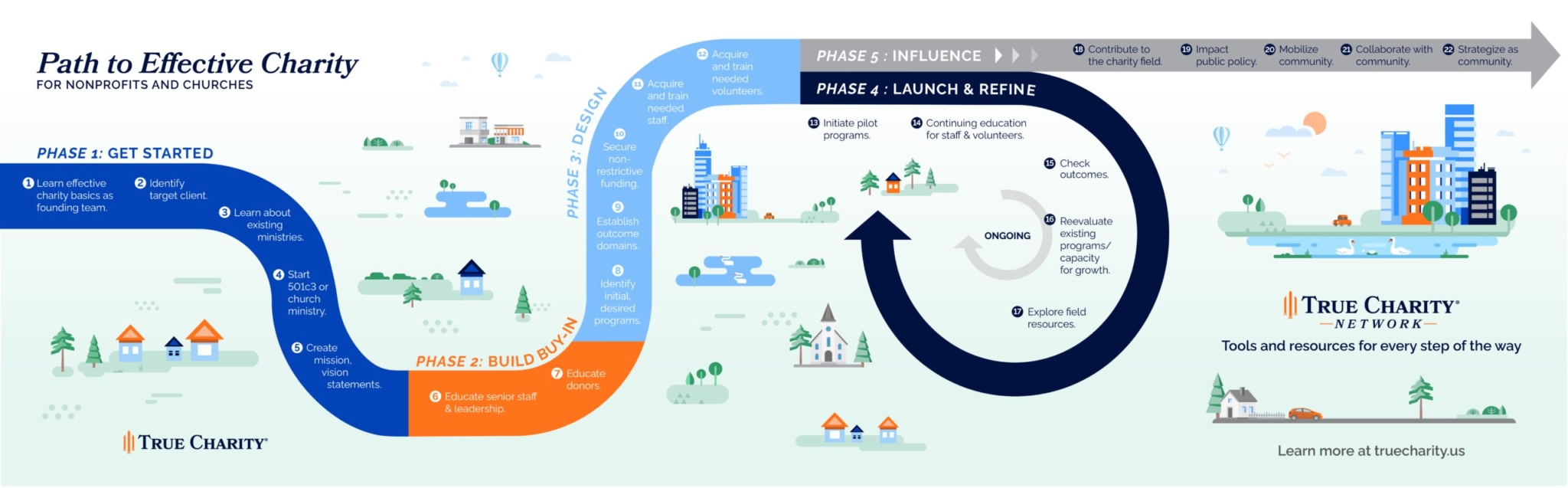
Specifically, after years of observation, we’ve noticed most network members journey through five phases:

  • Phase 1: Get Started
  • Phase 2: Build Buy-in
  • Phase 3: Program Design 
  • Phase 4: Launch & Refine
  • Phase 5: Influence Others

Where Do I Start on the Path?


Our team has created a simple quiz to help you discover your current location on The Path to Effective Charity. After you take the quiz, you’ll be placed within one of the five phases listed above. Then, you’ll receive recommended resources to help you succeed in that phase. 

As a bonus, you don’t have to be a network member to access this quiz. However, be aware recommended tools are reserved for network members. 

So if you are looking for a clearer path ahead, we invite you to discover your suggested next steps today by taking the The Path to Effective Charity quiz. We pray that with the Lord’s help, it will make all the difference in your ministry. 


Two roads diverged in a wood, and I—

I took the one less traveled by,

And that has made all the difference.


For more information on effective charity and how your organization can implement programs that deliver long-term results to those being served, visit truecharity.us/join.

Already a member? Access your resources in the member portal.

ALYSSA GLASGOW
Graphic Design Manager
Read more from Alyssa


Listen to this article:


Despite summer temperatures nearing triple digits, this is a great time to begin planning your Christmas outreach programs. If you’re thinking of starting a gift giveaway this Christmas or continuing one you’ve done for years, consider offering a Christmas Market instead! 

In a Christmas Market (or Affordable Christmas program) parents can shop and pay for highly-discounted gifts for their kids, which restores the parents’ dignity and strengthens family relationships. This format also allows your ministry to get to know families in your community in a way Traditional Giveaway programs do not. 

Changing a long-standing community tradition can be tough so here are five tools and templates to make the transition easier and ensure the Market’s success.

1. Donor Education Resource

Christmas Markets can only thrive with willing givers who donate their time, money, and resources. That means you must convince them their efforts will make an impact. 

Our two-page “Giving Guide” will do just that. It walks them through empowering charity basics and provides seven questions to help them assess a program’s effectiveness. 

2. Marketing Checklist

A lot of planning and detail go into a successful event. So, we’ve compiled a list of helpful tips for promoting your Christmas market, before, during, and after the event.

3. Event Flier and Donation List Template

A printed reminder to hang on the fridge is still valuable in this digital age. You can modify this flier template with your specific details and distribute it to local businesses–or hand it out around town. This recommended donation list can also be adapted for church and community members to add to their bulletin boards or to take home.

4. Powerpoint Slide and Social Media Graphics

Since we do live in a digital age, don’t forget to advertise in this space. Customize this Powerpoint slide to send to local churches for their morning announcements. We’ve also included social media graphic templates to increase community awareness and provide specific calls-to-action. 

5. Shopper Invitation Template

The goal is to encourage parents to shop at your Christmas market! You can use this template to invite them to participate. Thanks to Mile High Ministries of Denver, CO for providing the original content for this invitation. 


You can find more helpful resources through our Christmas Market Model Action Plan, available to True Charity Network members. It will give you step-by-step instructions that can be tailored to your community’s needs. It also highlights how multiple organizations have implemented Christmas programs to fit their unique contexts. All these programs share the common goal of building relationships, preserving dignity, and empowering families.


This article is just the tip of the iceberg for practical resources available through the True Charity Network. Check out how it can help you learn, connect, and influence here.

Already a member? Access all your benefits through the member portal.


Nathan Mayo
Vice President of Operations & Programs
Read more from Nathan


Listen to this article:


Over the years, I’ve had conversations with hundreds of ministry leaders who admit that they did as much harm as good in the early years of their work with the materially poor.

That’s understandable. Much of the learning we do in many areas of life is trial and error–and while legitimate and useful, it shouldn’t be our only approach.

Take medicine, for instance. True, research and technological advances are based on researched, refined, and perfected theories. But no one would allow a doctor to treat them if they learned he or she spent years making mistakes and was “just now getting the hang of it.” We rightfully expect medical professionals to avail themselves of medicine’s best practices in order to render the best possible care. That approach demands they take advantage of knowledge gained from other professionals doing the same thing. 

In similar fashion, many church and nonprofit leaders have discovered much of their trial and error could have been avoided had they taken advantage of the knowledge and skills developed by others doing the same work in other parts of the country. 

Indeed, if we want our ministries to be healthy, proactive learning from others doing similar work is essential. In other words, we shouldn’t waste time “reinventing the wheel.” Starting with ideas that have worked elsewhere–even if they could be improved–is far better than ignoring others’ wisdom and experience. Indeed, learning from their success doesn’t stifle creativity, it fuels it. Sadly, despite theoretical consensus on that point, too many of us act as though we’re the first person to run a benevolence ministry or developmental class. Therefore, we start everything from scratch. Here are a few ways to avoid that trap:

1)    Make Learning an Essential, Non-negotiable Priority.

The tyranny of the urgent makes holding to this difficult. However, we must realize making time to learn is foundational to humbly regarding others as more important than we are (Phil. 2:3). If we believe that’s the case, we’ll take advantage of every bit of wisdom needed to serve them well.

Valuing others also means valuing the insights of those doing the same or similar work. It readily admits “I don’t have all of the answers” and freely seeks out those who may have wisdom to share. As Proverbs 12:15 says, “The way of a fool is right in his own eyes, but a wise man listens to advice.” Thus, while making time to listen to wise counsel is a spiritual discipline that requires time and energy, in the end it will pay big dividends. 

It’s also important to schedule learning ahead of time. That may mean blocking off a few days for strategic planning once a year and a morning every month for research. At a minimum, be intentional about learning from others every quarter.

2)    Lay a Solid Theoretical Foundation.

When wading through a sea of information based on others’ experience, you need a way to sift the wheat from the chaff. Start by familiarizing yourself with important biblical passages that deal with compassion, mercy, justice, and charity. Isaiah 58, Matthew 25, and 1 Timothy 5 are good places to start. Reinforce that with good books that articulate God’s story of change like When Helping Hurts and Becoming Whole. Round that out with resources from other disciplines like psychology, economics, business, and sociology. Check out this library of book synopses and add some to your reading list.

3)    Learn What Similar Ministries are Doing.

None of our ministries are truly independent of each other. We’re all “franchises” of God’s mission and should freely share what we’ve learned with other “franchisees” in hopes they will do the same. 

Every time you want to start something new ask, “Who else is doing this?” While it can be challenging to find ministries doing it right, your theoretical foundation will help identify them. Because of how important we think sharing wisdom is, we’ve assembled extensive resources to help in your search. One such resource is our database of ministry features. Many leaders in that database are happy to take a call or let you tour their facility to learn how they operate.

Conferences are a great place to uncover best practices for specific ministry models like rescue missions, community development, or pregnancy resource centers. If you’re interested in effective service to the materially poor in the U.S., you can take advantage of our national conference for effective charity.

4)    Adapt Best Practices to Your Situation.

Culture, demographics, and resources vary, so every model should be adapted to your setting. In most regions, it’s possible to find ministries working in a similar context, which will make adapting their model easier. 

In the U.S., models like awards for growth programs, transitional housing, entrepreneur kids clubs, and work shuttles have been successfully adapted by numerous organizations. Refined out-of-the box programs like Faith and Finances will also enable you to run an excellent class from day one. In other words, innovation builds on innovation. 

How can you tell if a transplanted program is working? Our members have found intentionally measuring outcomes is the quickest way to discover what’s effective.

5)    Share What You’ve Learned.

It is more blessed to give than to receive (Acts 20:35). As you innovate, you’ll have plenty to share with leaders new to their ministries. That might involve having lunch with a new leader, speaking at a ministerial alliance meeting, or being quick to forward copies of operational documents. 

You may think lessons you’ve learned aren’t that special or won’t be helpful to others. That’s why it’s important to remember, perfection is the enemy of progress. If your model is good enough for you, someone else can learn from it. While it’s wise to restrict third parties from using your name (i.e. logos and phrases that would cause confusion about whether another ministry is operating under your management), you should feel free to release ideas with an open hand. In doing so, you’ll share in the growth of the Kingdom.

At the True Charity Network, we believe so strongly in these ideas that we’ve assembled a robust platform of resources to help you maximize your potential. In partnership with members who have learned from their mistakes, we’ve put together step-by-step guides for innovative models like food co-ops, affordable Christmas markets, and earn-it projects. In addition, digital toolkits are available to help with case management, outcomes measurement, and trauma-informed care. In other words, we are committed to serving you as a clearinghouse for ideas and effective models by “asset mapping” the effective charity movement.


This article is just the tip of the iceberg for practical resources available through the True Charity Network. Check out all the ways it can help you learn, connect, and influence here.

Already a member? Get access to all of your benefits through the member portal.