
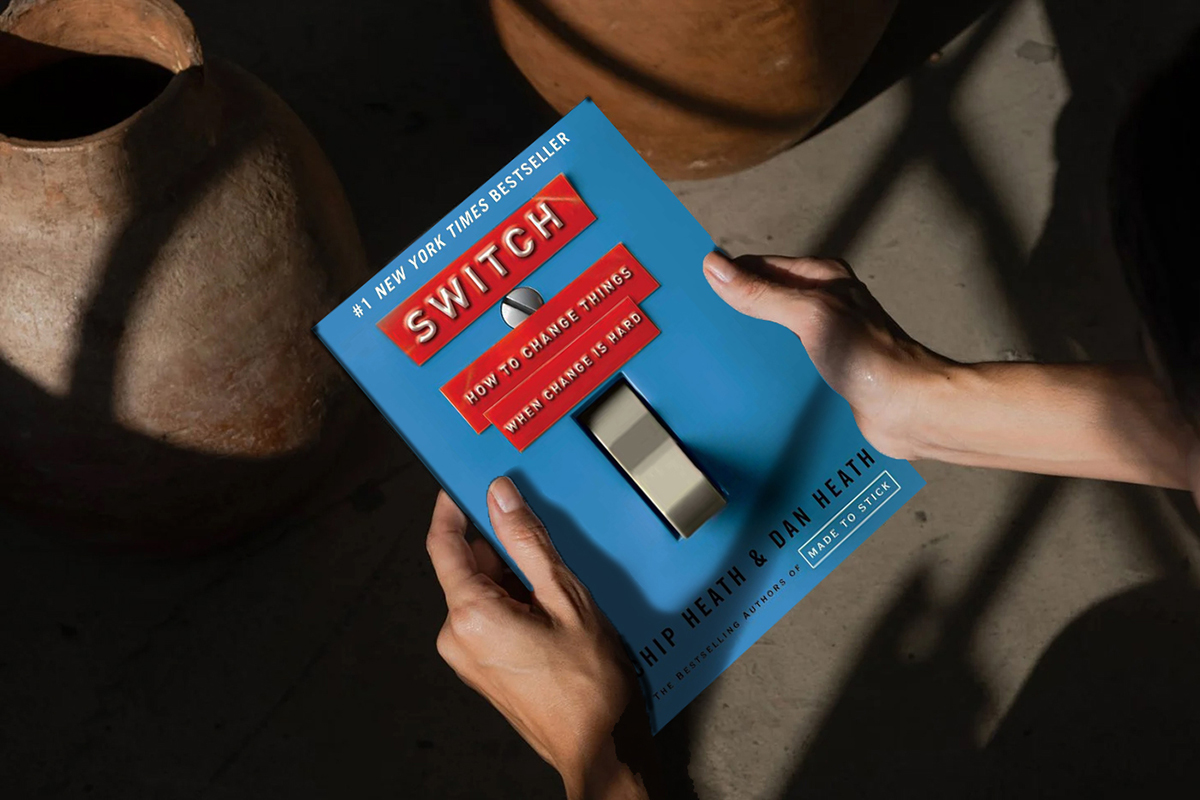
How to Change Things When Change is Hard: A Bird’s Eye View on the Book Switch by Chip and Dan Heath
 BETHANY HERRON
Vice President of Education
Read more from Bethany
Listen to this article:
Check out True Charity Ennoble on Apple Podcasts and Spotify.

The Purpose of the Book
The Heath brothers write to help readers create change in their lives, communities, and organizations — which they realize is no easy task. To enable success, they focus our attention on the importance of engaging the rational and emotional parts of our brain.
The Perspective
The authors write from a purely psychological, secular perspective. They use the metaphor of the Rider (the rational mind), the Elephant (the emotional mind), and the Path as a framework for understanding how to direct change. “The world doesn’t always want what you want. You want to change how others are acting, but they get a vote … To change behaviour, you’ve got to direct the Rider, motivate the Elephant, and shape the Path” (p. 18).
The Key Points
The Heaths focus on three major points:
Direct the rider.
When navigating change, the Rider is that part of our brain that logically thinks through every possible scenario. To direct him, one shouldn’t focus on what isn’t working or what needs to be changed. Instead, we should prioritize the “bright spots.” By focusing on what already works well, individuals can reinforce productive behaviors or habits and minimize the mental exhaustion change brings.
The authors also highlight the importance of “scripting the critical moves” to give the Rider a clear next step. For example, it’s more effective to tell someone trying to get healthier, “Buy 1% milk,” rather than the vague instruction, “Shop for healthy food.” That level of specificity helps the Rider know exactly what steps to take instead of wasting mental energy deciding what to do. As they put it, the Rider needs to know where he is going, “… and for that to happen, you need a gut-smacking goal!” (p. 81).
Motivate the elephant.
The Elephant is an entirely different beast. To walk through change, we must convince the emotional part of our brain to move.
That’s easier said than done because the Elephant always looks for the easiest path — and change is seldom easy. Thus, the authors stress the importance of “shrinking the change” so we can gain confidence it can be accomplished. “If people are facing a daunting task [and change is always daunting to some!] and their instinct is to avoid it, you’ve got to break down the task … making it small enough that they can’t help but score a victory” (p. 134).
Shape the path.
Confusion kills momentum. For that reason, not only does a person need to know what to do and be motivated to do it, the situation itself must be primed for change.
That’s why the authors encourage readers to build systems that enable right behaviors. In charity work, that can be as simple as equipping your team with goal-setting training and clear processes, so they know exactly what it looks like to take a relational, empowering approach with clients.
Finally, the authors encourage readers to “rally the herd,” i.e., surround themselves with people doing what they want to do. As the old saying goes, there’s strength in numbers — so changing together is a great way to enhance the chance for success.
Details We Love
We appreciate the Heath brothers’ use of the Rider, Elephant, and Path to make the intricacies of change theory accessible. While many change theorists present a more academic framework, the Heaths understand the human aspect of change, highlighting the importance of its logical, emotional, and situational elements.
In poverty alleviation, pursuing organizational change — or working with a client to move closer to flourishing — often involves mid-course setbacks. Thus, it’s easy to feel defeated. That’s why we appreciate the authors’ emphasis on “engineering hope by shrinking the change.” Doing so (especially early on) makes interim change achievable, increases confidence, and makes long-term change more probable.
Finally, we appreciate the authors’ insight on reigning in emotions that may distract us from decisions based on best practices (something they call “pre-loading difficult decisions”).
As you try to make a switch, the hardest struggle will be to maintain your motivation, to keep your Elephant on the road. This puts a huge burden on your Rider, who has to rein in the Elephant when it strays … Even a simple checklist can make a difference [because it removes the Elephant, and it’s just the Rider and the Path], p. 223.
When ministry workers decide their processes beforehand and build them into their workflow, it becomes easier to stay aligned with effective charity principles.
Considerations
While Switch offers fantastic psychological guidance, as mentioned before it’s written from a purely secular perspective. Therefore, the authors don’t address the spiritual side of personal transformation. To put it another way, while psychological insight and strategic methodology is of some value in organizational change, deeper personal reformation involves a more profound shaping of the mind, body, and will. Repentance from sin and a reliance on the Holy Spirit are critical to that success.
As well, the authors struggle to balance the tension between “shaping the path” and effort and hardship as a means to build character. They comment that “what looks like a people problem is often a situation problem,” explaining that exhaustion is often mistaken for laziness. Yet, while it is helpful and essential to make change accessible and achievable, individuals shouldn’t be excused from taking ownership of their actions — past and present. Every person has a stewardship responsibility to exercise agency and care over what God has placed in our hands, whether that path is easy or difficult.
Who Should Read This?
If you’ve ever wondered why your “campaign” didn’t lead to the organizational change you hoped for …
If you’re a case manager wondering how to help clients “shrink the change” or “see the bright spots” …
If you’re a ministry leader trying to get your team or congregation on board with effective charity principles or a refined benevolence program …
Switch will prove helpful in establishing lasting cultural and programmatic change — and alongside the Scriptures — serve as a useful supplement to the personal change you hope to lead others to as you help them shape their path to a better future.
Switch can be purchased at Amazon. If you purchase the book through this link, True Charity will earn a small amount as an Amazon Associate.