
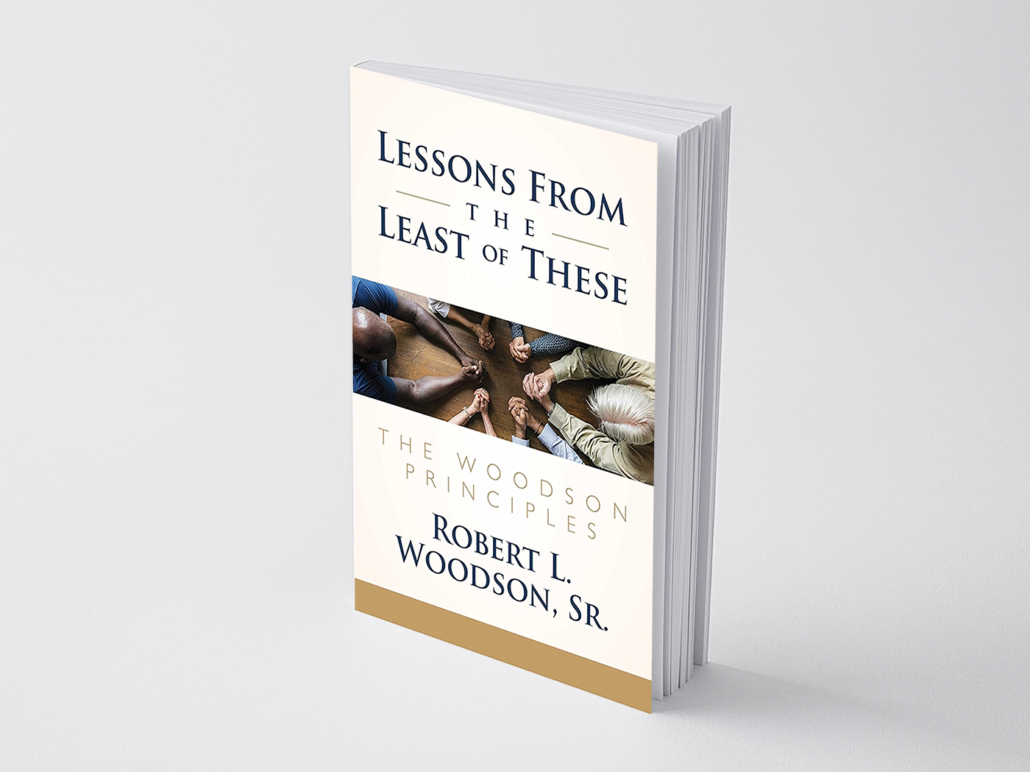
A Review of Lessons From the Least of These by Robert L. Woodson

Listen to this article:
Check out True Charity Ennoble on Apple Podcasts and Spotify.
 The Purpose of the Book
During his fieldwork and research at the American Enterprise Institute, Robert L. Woodson, Sr., noticed the impact grassroots organizations were having on low-income neighborhoods throughout the country. In response, he founded the National Center for Neighborhood Enterprise (now known as the Woodson Center) to replicate the successful strategies and methods he observed.
Out of that comes his book, Lessons From the Least of These, in which he maps out 10 “Principles of Neighborhood Enterprise.” Each closely aligns with True Charity’s values and philosophy — especially the value we place on subsidiarity, i.e., those closest to the problem are best-equipped to solve it.
The Perspective
He begins by stating, “As a Black man who grew up primarily in a low-income neighborhood, I am well aware of the legacy of slavery, Jim Crow laws, and legalized racial discrimination. My mother was one of the many Black parents from that era who told me that I would have to work twice as hard in order to prove myself. I took her advice and did just that, putting myself through school, serving in the military and leading various urban renewal organizations across my career.” (p. xix)
Remarkably, though he experienced racism and prejudice firsthand, Woodson says he never considered himself a victim. Instead, he embraced the belief that “the only path for bettering one’s self and one’s life is through taking responsibility for one’s own uplift” (page xix). He relates numerous examples from the Black community that support that idea, highlighting those whose personal agency, empowered by strength and determination, led them to succeed — despite unjust laws and systems.
Unfortunately, the dissolution of personal agency has permeated our society, advanced by many government programs and poverty alleviation strategies that fail to regard individual uniqueness and personal autonomy. As a result, the family unit is broken, crime and violence have taken over poor neighborhoods, and welfare programs aren’t making a dent in poverty (p. xx).
Woodson believes, “It is clear we need a different approach … and I have found it where you would least expect” (page xx): grassroot leaders, living in the middle of poor, broken communities, bringing about transformation. Very few are “experts” with university degrees. But virtually all of them know poverty and hardship firsthand — as evidenced by and nearly 80% having an “ex” in their title (i.e., ex-con, ex-drug addict, etc.). That means they know what personal redemption is like, and how to help “the least of these” achieve it. In Woodson’s words, “They reach out to those in need with the attitude and belief that people are capable of being agents of their own uplift.” (p. xx)
The Key Points
Woodson’s 10 “Principles of Neighborhood Enterprise” include: competence, integrity, transparency, resilience, witness, innovation, inspiration, agency, access, and grace. He expounds on each with practical application and case studies that follow a similar pattern:
- Change begins small, starting with a resident sick of living in a dangerous, chaotic neighborhood who steps up to initiate a change.
- He or she bravely builds relationships with some of the roughest figures in the community (including gang leaders and drug dealers).
- Through those relationships, residents encounter Christ’s redeeming power and undergo personal transformation.
- Leveraging their previously established “leadership,” these former criminals become “ambassadors of peace” and lead the charge for complete neighborhood transformation. In other words, problems are solved when hearts are transformed from the inside out.
“Unheralded community groups and violence-fighting programs hold the key to changing this country … Economic development, education, and other well-meaning programs won’t matter unless there’s peace in the streets. The peace can only come when predators can be converted to ambassadors of peace.” (p. 129)
Details We Love
Probably without realizing it, Bob Woodson could be an author for True Charity, as his book is dripping with principles True Charity holds dear. Key themes emphasized throughout include:
- Personal agency: People should be agents of their own uplift. (p. 3)
- Reciprocity and exchange: “…a true act of compassion does not require the surrender of self-respect in exchange for assistance. The principle of reciprocity should guide the philanthropic exchange just as it guides exchange in the marketplace. People who are constantly on the receiving end, who have never been given the opportunity to reciprocate, will in due time despise not only the gift, but also the gift giver.” (p. 96)
- Subsidiarity: “Look first among people suffering the problem for a solution.” (p. 1) In other words, those living in a broken community know how to address their problems better than distant bureaucracies further removed from the situation.
- The importance of relationships: Those who provide “relational treatment and healing become examples others can look up to and live by.” (p. 85)
- Poverty is complex. Therefore one-size-fits-all solutions don’t work. Instead, personalized care and unique solutions are needed: “Solving poverty is not about systems, delivery, program, or service. It’s about individual human beings who have complex needs and live in complex circumstances. That’s what makes public policy so difficult to create and orchestrate.” (p. 98)
- Empowering civil society in the fight against poverty. (p. 38)
Considerations
As a Black man, Woodson focuses much of the book’s commentary on fighting poverty in the Black community. However, his principles and advice are equally applicable in other demographic communities.
And while Woodson offers case studies to illustrate the practical application of “Principles of Neighborhood Enterprise,” it can be difficult to bridge the gap between theory and practice. Thankfully, the True Charity Network exists to help you apply these ideas in your specific context.
Who Should Read This?
If you have a heart to see broken communities transformed …
If you are tired of seeing top-down solutions that only provide a band-aid to the root causes of poverty …
And if you long to see civil society take the lead in the fight against poverty …
Bob Woodson provides hope that those dreams can become reality. Lessons From the Least of These will inspire anyone involved in poverty alleviation to dream big and pray with expectation — particularly those involved in community transformation ministries.
Lessons from The Least of These can be purchased at Amazon. If you purchase the book through this link, True Charity will earn a small amount as an Amazon Associate.
This article is just the tip of the iceberg for the practical resources available through the True Charity Network. Check out all of the ways the network can help you learn, connect, and influence here.
Already a member? Get access to all of your benefits through the member portal.